PNX Automation is expanding its service portfolio, with PNX Charge we develop straightforward modular charging infrastructure for residential buildings, businesses, fleets and parking areas, from a single charging point to scalable solutions

Camera-Based Vision, Servo Drives, and AI-Based Adaptive Control – The Future of High-Precision Registration Control in Sheet Cutting
How camera-based vision, servo drives, and AI-based adaptive control are transforming registration accuracy in modern sheet-cutting machines.
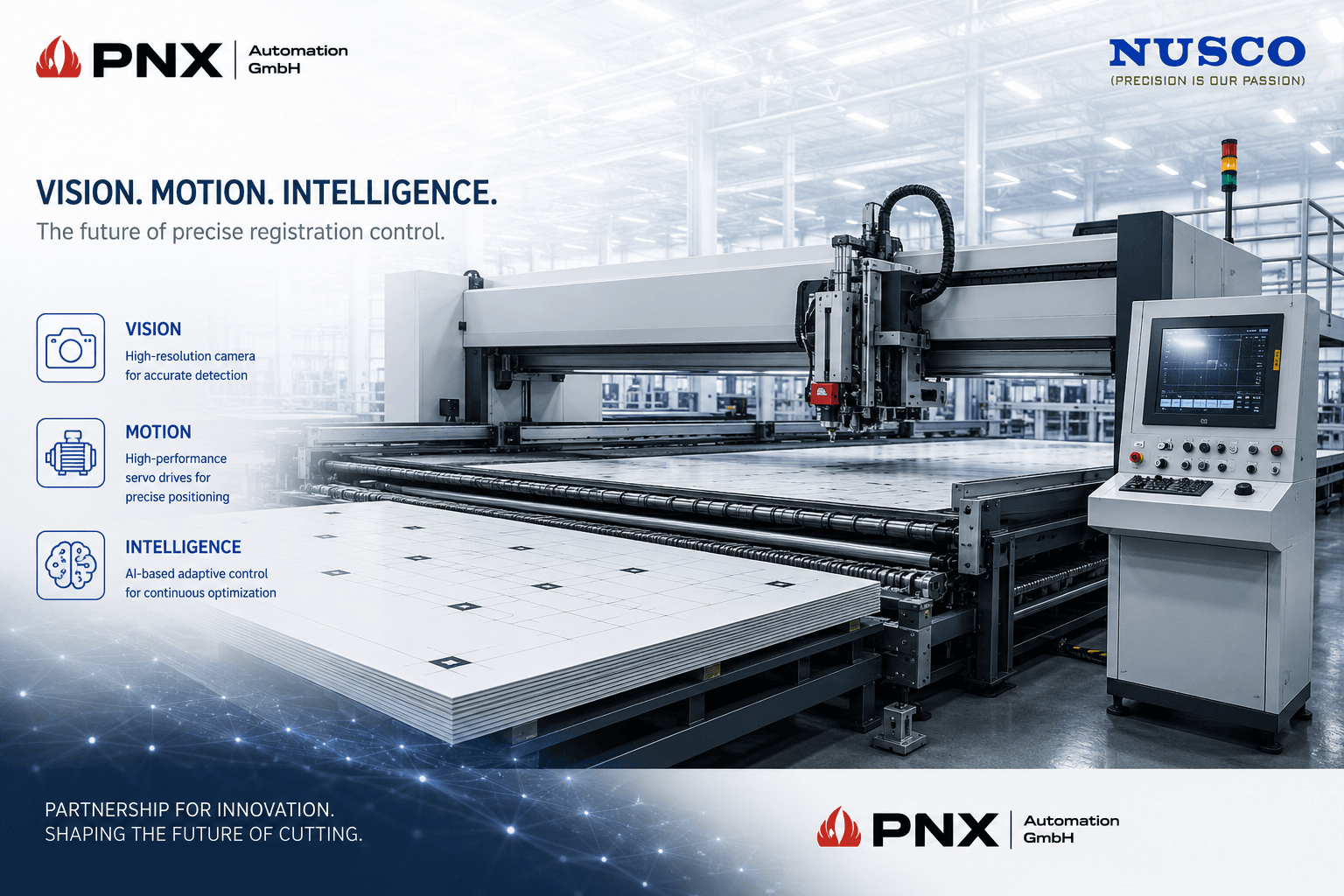
Camera-Based Vision, Servo Drives, and AI-Based Adaptive Control – The Future of High-Precision Registration Control in Sheet Cutting
The demands placed on modern sheet-cutting machines continue to increase. Shorter production cycles, reduced material waste, and consistently high product quality require increasingly intelligent automation solutions. In particular, registration control plays a crucial role in determining the dimensional accuracy and quality of the final product. While conventional systems rely on photoelectric sensors or mechanical stops, a new generation of intelligent systems is emerging that combines industrial machine vision, servo drives, and artificial intelligence (AI)-based adaptive control.
This integrated approach enables machines not only to detect positional deviations but also to compensate for them automatically during the production process, ensuring consistently high cutting accuracy under varying operating conditions.
Camera-Based Position Detection
The first component of the system is industrial machine vision. High-resolution cameras capture every sheet immediately before the cutting process. Modern vision systems are capable of determining not only the sheet position but also additional parameters such as:
- Longitudinal and transverse displacement (X- and Y-axis)
- Angular misalignment (sheet skew)
- Material stretching or shrinkage
- Printed registration marks
- Part contours and geometric features
Unlike conventional optical sensors, cameras provide a complete image of the sheet. This allows multiple quality characteristics to be evaluated simultaneously, significantly improving process reliability. Vision-based servo control systems are increasingly used to achieve precise positioning by continuously correcting motion based on visual feedback.
Servo Drives as High-Performance Actuators
Once the camera system has determined the actual sheet position, the servo drive performs the required correction.
Compared with pneumatic actuators or open-loop stepper motor systems, servo drives offer several significant advantages:
- High positioning accuracy
- Fast dynamic response
- Continuous closed-loop motion control
- Excellent repeatability
- Seamless integration into modern motion-control architectures
Using high-resolution encoders, the servo controller continuously monitors the exact position of each axis. As a result, even very small registration errors—often well below one millimeter—can be corrected accurately and repeatably.
The overall control strategy follows a closed-loop sequence:
Camera → Controller → Servo Drive → Camera Feedback
This continuous feedback loop ensures that positional deviations are corrected before the cutting operation is executed.
AI-Based Adaptive Control
Traditional control systems rely on fixed controller parameters that must be tuned manually. However, production environments are subject to constantly changing conditions that can influence registration accuracy.
Adaptive control systems overcome this limitation by continuously analyzing process data and automatically adjusting controller parameters in real time.
Typical influencing factors include:
- Different paper and board grades
- Material humidity
- Temperature variations
- Mechanical wear
- Production speed
- Recurring process disturbances
Artificial intelligence and machine learning algorithms identify patterns within production data and predict the optimal control actions for changing operating conditions. Instead of merely reacting to errors after they occur, AI-supported systems can anticipate deviations and compensate for them proactively.
Recent research demonstrates that combining vision-based control with adaptive parameter estimation and intelligent observers significantly improves positioning performance, even under disturbances or temporary loss of visual information.
Integration of Camera, Servo Drive, and AI
The complete registration process can be summarized in five sequential steps:
- An industrial camera captures the incoming sheet.
- Machine vision algorithms determine positional and angular deviations.
- An adaptive AI controller evaluates additional process and material information.
- Servo drives correct the sheet position in real time.
- The cutting operation is performed only after the desired registration accuracy has been achieved.
This closed-loop architecture allows every individual sheet to be measured and aligned independently, ensuring consistent cutting accuracy despite variations in material properties or production conditions.
Advantages over Conventional Systems
The combination of machine vision, servo technology, and AI-based adaptive control offers several important advantages:
- Improved registration accuracy
- Reduced material waste
- Faster setup for new production jobs
- Automatic adaptation to different materials
- Higher production speeds
- Shorter changeover times
- Reduced maintenance through intelligent condition monitoring
These advantages are particularly valuable in high-speed sheet-cutting applications where product quality and manufacturing efficiency are directly linked to registration performance.
Future Outlook
The next generation of sheet-cutting systems is moving toward fully self-optimizing production environments. Future machines will continuously collect operational data, analyze process behavior using artificial intelligence, and automatically optimize their control parameters without manual intervention.
Combined with technologies such as digital twins, edge computing, and advanced motion controllers, intelligent registration systems will become increasingly autonomous, flexible, and efficient. This development represents an essential step toward Industry 4.0 and smart manufacturing.
The integration of industrial machine vision, precision servo drives, and AI-based adaptive control is therefore emerging as the state of the art in modern sheet-cutting registration systems, enabling higher precision, increased productivity, and greater operational flexibility.